

Introduction:
Artificial Intelligence (AI) is rapidly reshaping how businesses operate, and SMEs are no exception. This module provides a clear and practical introduction to AI, focusing on what it is, how it can be applied in small businesses, and the strategies SMEs can use to adopt it effectively. Through examples, trends, and real use cases, you will discover how AI can drive efficiency, reduce costs, and improve customer experiences. The module is designed to build confidence and provide simple steps to start your AI journey.
Learning outcomes
By completing Module 1 – AI Essentials for SMEs (AI Basics & Trends), you will be able to:
- Explain what AI is and describe its most common applications for SMEs.
- Identify key global and European trends in AI adoption.
- Recognise sector-specific use cases of AI relevant to SMEs.
- Evaluate simple, ready-made AI tools suitable for small businesses.
- Apply the Taker Strategy to test and integrate AI tools in your own organisation.
Units in this Module
Unit 1: AI Basics
Introduction:
This unit introduces the fundamental concepts of Artificial Intelligence (AI) in a way that connects directly to the realities of running a small or medium-sized business. You will explore what AI is, how it works at a practical level, and the different forms it takes in business today. The focus is on relevance and application: how AI can enhance decision-making, reduce costs, and free up valuable time. By the end of this unit, you will be able to recognise opportunities where AI could provide measurable benefits for your own organisation.
What is Artificial Intelligence (AI)?
AI refers to the ability of machines to carry out tasks that normally require human intelligence, such as:
- Understanding language (like email auto-replies)
- Learning from data (like predicting stock needs)
- Making decisions (like choosing the best delivery route)
- Generating content (like writing a product description)
Example: A small café uses an AI chatbot on their website to answer common questions about menu items, saving hours per week in staff time.
How does AI Work?
In simple terms, AI learns from data.
- Input: The AI system is fed examples (e.g., emails, sales data)
- Pattern recognition: It finds patterns (e.g., most common queries)
- Action: It responds or predicts (e.g., generates an answer)
This process is called machine learning, and it’s what powers most AI tools today.
Watch the following video to learn more about how AI works: https://youtu.be/2ePf9rue1Ao?si=4Dd39nqkus2nh631
Types of AI
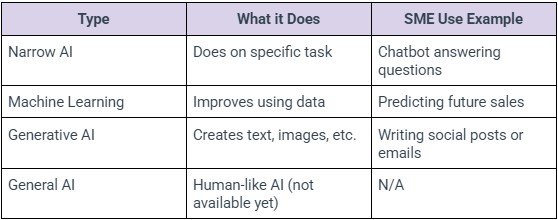
Why AI Matters for SMEs
AI adoption is no longer optional, it is a growing competitive necessity. By automating repetitive tasks, SMEs can ensure more consistent service delivery and respond to customer needs faster.
Some of the most common benefits for SMEs include:
Time Saving: Automates routine tasks like appointment booking, order processing
Cost Reduction: Reduces need for outsourced work (e.g. copywriting, transcription)
Better Decisions: Offers data-driven insights to support planning and forecasting
Improved Customer Experience: Enables faster responses, personalisation, and around-the-clock service.
In e-commerce, AI-powered chatbots and virtual assistants reduced customer response times by 40%, lowered operational costs by 20–30%, and boosted overall customer satisfaction (Umutoni, 2025).
Reference: Umutoni, A. (2025). The influence of artificial intelligence on customer service automation in e-commerce in Rwanda. International Journal of Technology and Systems, 10(1), (No. 4), 57–68.
Common AI Myths
Myth
Reality
“AI is only for big corporations” | Over 55% of EU SMEs use at least one AI tool |
“You need coding skills to use AI” | Many tools (e.g., Canva AI, Tidio) require no coding |
“AI will replace all jobs” | AI tends to enhance roles, shifting staff to higher-value work |
“AI is 100% accurate” | AI requires oversight. Outputs improve with use |
Tools SMEs Can Use Today
Tool
Purpose
Example
ChatGPT

Content Generation
Write FAQs, emails
Canva AI

Design Support
Flyers, social media posts
Otter.ai
Meeting Transcription
Summarise client meetings
Tidio

AI chatbox
Website customer service
Grammarly AI

Writing improvement
Polished professional emails
Note: Logos are the property of their respective owners and are used here for educational purposes only. No endorsement is implied.
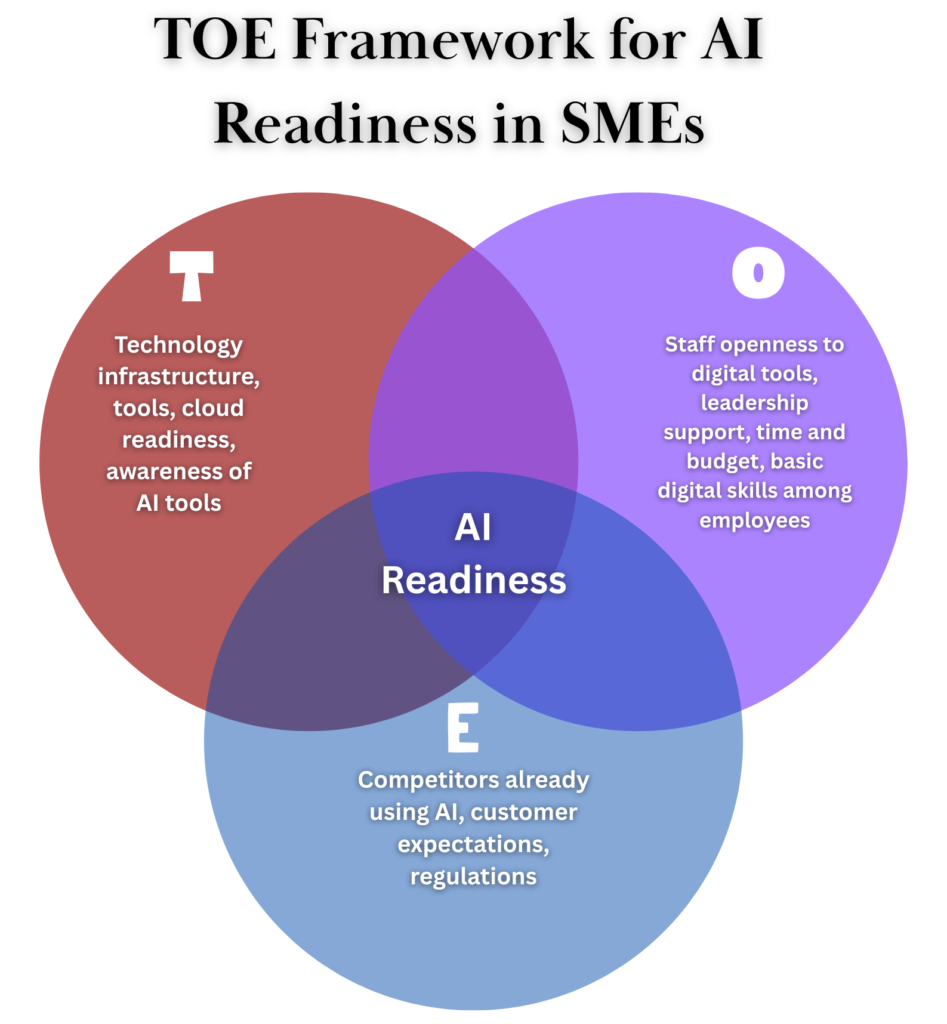
Thinking Framework: TOE for AI Readiness
The TOE Framework (Technology–Organisation–Environment) is a model originally developed by Tornatzky & Fleischer (1990) to explain why some businesses adopt new technologies faster than others. It helps SMEs think about adoption not just in terms of tools, but also internal readiness and external pressures.
Technology
This refers to the technical resources your business already has, and how suitable they are for using AI. For SMEs, this doesn’t mean advanced infrastructure, it’s about basics such as:
- Reliable internet access
- Modern computers or smartphones
- Use of cloud tools (Google Workspace, Office 365, etc.)
- Awareness of available AI applications
If you already use digital platforms, you’re likely ready to pilot AI tools.
Organisation
This looks at your internal capacity to adopt AI. Even if the technology exists, adoption depends on factors such as:
- Management support for innovation
- Openness of staff to try new tools
- Available time or budget for small pilots
- Skills and digital literacy in the workforce
If staff see AI as an opportunity rather than a threat, adoption is smoother.
Environment
This covers the external pressures that push SMEs toward adoption:
- Customers expecting faster responses and personalised service
- Competitors already using AI to reduce costs or improve quality
- Regulations encouraging or mandating digital tools
- Industry networks (such as chambers of commerce) promoting AI use
If competitors are gaining an advantage with AI, waiting too long may increase business risks.
TOE Framework Self-Assessment: Is Your SME Ready for AI?
For each area below, tick the option that best matches your business today.
Area | Ready | Partially Ready | Needs Work |
Technology | We have reliable internet, modern devices, and already use cloud tools | We have internet and devices, but limited use of cloud tools | Our infrastructure is outdated and limits digital adoption |
Organisation | Leadership supports digital innovation; staff are open to AI; we have time/budget for pilots | Leadership is supportive, but staff skills or time are limited | Little buy-in from leadership or staff; no resources for pilots |
Environment | Competitors use AI; customers expect fast service; industry/regulation pushes adoption | Some competitors are trying AI; customer expectations are rising | No visible external pressure yet |
Reflection
- Which area scored “Ready”? This is your strength.
- Which area scored “Needs Work”? This is your barrier.
Focus first on areas marked “Partially Ready” — small improvements there can quickly boost overall AI readiness.
Unit 1 Recap
- AI is extremely beneficial for SMEs, with measurable gains in efficiency and customer satisfaction.
- Generative AI tools are fastest growing due to ease of use and low cost.
- The TOE Framework helps SMEs evaluate readiness before investing in tools.
Unit 1 References:
Umutoni, A. (2025). The Influence of Artificial Intelligence on Customer Service Automation in E-Commerce in Rwanda. Applied Sciences, 15(6465), 1–15. https://doi.org/10.3390/app15064665
Unit 2 – Trends & Use Cases
Introduction:
Artificial Intelligence is no longer limited to large corporations. Across Europe and the world, small and medium-sized enterprises (SMEs) are already adopting AI to improve efficiency, reduce costs, and deliver better customer experiences. This unit explores the main trends in AI adoption, highlights real examples from SMEs in different sectors, and provides space for you to reflect on how these trends might apply in your own business.
Current Global & European Trends in AI Adoption
Global
AI adoption is now mainstream worldwide. According to McKinsey (2025), 78% of organisations globally reported using AI in at least one business function in 2024 — a sharp rise from 55% in 2023. The most common areas of use are marketing, customer operations, product development, and service delivery. Generative AI in particular has driven this growth, with 65% of organisations reporting regular use of generative AI tools across business functions.
Implication: AI adoption is no longer limited to large corporations; the global business environment is being reshaped by rapid AI integration.
Reference: McKinsey & Company (2025). The State of AI: How Organizations Are Rewiring to Capture Value.

Europe (SME Focus)
In contrast, adoption among European SMEs is still limited. A review by Schwaeke et al. (2025) found that only 6.9% of SMEs in Europe had adopted AI, and 8.3% had adopted robotics by 2025. Adoption levels vary significantly across regions and industries:
- In Italy, just 14% of SMEs use AI, and nearly half report no plans for future adoption (Proietti et al., 2025).
- A large-scale survey of over 12,000 European SMEs confirmed that internal digital and innovation capabilities are far more decisive for AI adoption than external policy support.
- SMEs with higher digital maturity are 52% more likely to adopt AI than digitally lagging peers (Arroyabe et al., 2024).
- Sectors with early uptake include retail/e-commerce, manufacturing, and services, where automation and customer-facing tools create faster returns.
Implication: While large firms and global markets are moving fast, many European SMEs are only beginning their AI journey. This gap represents both a challenge and an opportunity: SMEs that move sooner can gain a first-mover advantage in their sector.
References:
Proietti, P., Cesaroni, F. M., Sentuti, A., & Buratti, A. (2025). Artificial Intelligence Adoption in Italian SMEs: Drivers, Barriers, and Future Prospects. Journal of Small Business and Enterprise Development, 32(1), 45–67. https://doi.org/10.1108/JSBED-07-2024-0321
Arroyabe, M. F., Arranz, C. F. A., Fernandez de Arroyabe, I., & Fernandez de Arroyabe, J. C. (2024). Analyzing AI adoption in European SMEs: A study of digital capabilities, innovation, and external environment. Technology in Society, 79, 102733. https://doi.org/10.1016/j.techsoc.2024.102733
Emerging SME AI Trends
AI adoption is not only growing in scale but also diverging in style between large enterprises and SMEs.
- Large enterprises often deploy AI across several departments at once, using a mix of internal development teams, enterprise-level cloud AI platforms (like Google Vertex AI or AWS Bedrock), and external providers. This approach allows them to customise AI solutions and integrate them deeply into existing systems.
- SMEs, in contrast, tend to adopt ready-made, subscription-based tools that are quicker and easier to implement. Examples include:
- ChatGPT Enterprise for advanced knowledge and content generation
- Canva’s AI assistant for marketing design
- HubSpot’s AI-powered CRM for customer management
- Jasper for copywriting and campaign content
Implication: Large firms leverage AI as part of a complex, company-wide digital strategy, while SMEs often find value in targeted, accessible tools that deliver immediate benefits without the need for specialist technical teams.
Reference: Founders Forum Group (2025). AI Statistics 2024–2025: Global Trends, Market Growth & Adoption Data.
SME Use Cases by Sector
🛒 Retail & E-commerce
- AI chatbots for FAQs
- Generative AI for product descriptions
- Inventory forecasting tools
Example tools: Tidio, Intercom, ManyChat (chatbots); ChatGPT, Jasper (product descriptions); Zoho Inventory AI, Shopify AI tools (forecasting).
🏨 Hospitality & Tourism
- Chatbots for booking enquiries
- AI-driven recommendations for guests
- Sentiment analysis of reviews
Example tools: HiJiffy, BookMeBob (booking chatbots); MonkeyLearn, Reputology (review analysis); Quicktext, Allora AI (guest personalisation).
🏭 Manufacturing & Logistics
- Predictive maintenance reducing downtime by up to 30%
- AI route optimisation
- Anomaly detection in quality control
Example tools: Seebo, Augury (predictive maintenance); OptimoRoute, Routific (route optimisation); LandingLens, Covision Quality (computer vision for QA).
📢 Marketing & Sales
- Generative AI content creation
- Customer segmentation & lead scoring
- Automated design suppor
Example tools: Jasper, Copy.ai (content creation); Canva AI, Adobe Firefly (design); HubSpot AI, Zoho CRM (analytics and targeting).
💼 HR & Recruitment
- Automated CV screening
- Inclusive job ad generation
- Transcription & interview analysis
Example tools: HireVue, Pymetrics (CV screening); Textio (job ad optimisation); Otter.ai, Fireflies.ai (meeting transcription)
💲Finance & Accounting
- Automated invoice processing and expense categorisation
- Cashflow forecasting and budget analysis
- AI-driven fraud detection
Example tools: QuickBooks AI, Xero AI Assistant (accounting automation); Planful, Float (forecasting); Stripe Radar, SEON (fraud detection).
🏥 Healthcare & Wellness
- AI assistants for appointment scheduling
- Chatbots for patient triage and FAQs
- Predictive health monitoring with wearables
Example tools: Doctolib AI, HealthHero (scheduling & triage); Babylon Health, Ada Health (chatbots); Biofourmis, Fitbit AI analytics (predictive health).
🎓 Education & Training
- AI tutors for personalised learning paths
- Automated grading and assessment
- Content generation for lesson planning
Example tools: Khanmigo, Querium (AI tutoring); Gradescope, ScribeSense (grading); Quizlet AI, Google Classroom add-ons (content generation).
🎨 Creative Industries
- AI-assisted video editing and production
- AI for scriptwriting, storyboarding, and music generation
- Generative image design and animation
Example tools: Synthesia, Runway ML (video AI); Jasper, Sudowrite (scriptwriting); Adobe Firefly, Stable Diffusion (image & design).
Investment Trends (2025)
Company | Country | Sector | 2025 Round Size |
Anthropic | USA | Safety-focused LLMs | ~€2.53B |
OpenAI | USA | Foundation Models | ~€2.30B |
Mistral AI | France | LLM Infrastructure | ~€589M |
Synthesia | UK | Video GenAI | ~€138M |
Character-AI | USA | Chat AI | ~€92M |
Aleph Alpha | Germany | Sovereign LLMs | ~€500M+ |
Deepl | Germany | NLP Translation | ~€300M |
Massive global investment in AI startups signals the direction of innovation. For SME leaders, whether you manage HR, marketing, or operations, this means the tools being funded today will quickly become the off-the-shelf solutions available to your business tomorrow. Knowing where the money flows helps you anticipate which AI applications (translation, video, customer service, automation) will become most affordable and widespread in the near future.
Reference: Founders Forum Group (2025). AI Statistics 2024–2025: Global Trends, Market Growth & Adoption Data.
Responsible AI
With regulation (e.g., the EU AI Act) approaching, SMEs must also consider responsible AI:
- Protecting customer data
- Ensuring transparency in AI use
- Building trust with clients
Responsible adoption is not only compliance — it’s a competitive advantage.
Reflection Activity
Unit 2 Recap
- AI adoption is accelerating globally, but European SMEs are still behind.
- SMEs benefit most from accessible, ready-made tools rather than complex custom systems.
- Practical use cases across retail, hospitality, manufacturing, marketing, and HR show real efficiency gains.
- Growing investment in AI startups signals that more affordable SME-ready tools are on the way.
- Responsible AI builds trust and prepares SMEs for upcoming EU regulations.
Unit 3: The Taker Strategy
Introduction:
Many SMEs believe adopting AI requires massive budgets, large IT teams, or deep technical expertise. In reality, most small businesses can benefit from AI today by following a simple “Taker Strategy”, using existing, affordable tools “off the shelf” rather than building AI solutions from scratch.
This unit explains the Taker Strategy, shows how SMEs are already applying it, and provides a step-by-step guide for getting started.
What is the Taker Strategy?
The Taker Strategy means taking advantage of existing AI tools and platforms, rather than creating your own models or systems.
- Makers (large enterprises) → Build proprietary AI models (e.g., Amazon Alexa, Google Translate, OpenAI GPT models).
- Takers (SMEs) → Use ready-made tools that integrate easily into workflows.
Implication: SMEs can access world-class AI capabilities with minimal cost, because someone else has already invested billions in creating and training the models.
Why the Taker Strategy Works for SMEs
- Low Cost: Most tools are free or subscription-based (often under €50/month).
- No Technical Expertise Needed: Tools are designed for non-programmers with simple interfaces.
- Immediate Value: Quick setup and results (e.g., hours saved, better content, faster customer responses).
- Scalability: Start small with one tool and expand as confidence grows.
OECD (2025) highlights that SMEs adopting AI see measurable efficiency gains, especially in administrative and repetitive tasks, while a University of Manchester (2024) study on micro and small enterprises found that generative AI pilots led to significant time savings, with some firms reporting reductions of several hours of manual work per employee each week.
References:
OECD. (2025). Emerging divides in the transition to artificial intelligence. OECD Publishing. https://doi.org/10.1787/eeb5e120-en
University of Manchester. (2024). AI Catalyst: Cracking the code for MSME productivity. Alliance Manchester Business School, University of Manchester. Retrieved from https://www.alliancembs.manchester.ac.uk/research/ai-catalyst/
How to Evaluate AI Tools Before Adopting?
Before adopting any AI tool, SMEs should ask five key questions:
- Relevance – Does this tool solve a real problem or pain point in our business?
- Ease of Use – Can non-technical staff learn it quickly?
- Cost – Is the pricing transparent and affordable (ideally monthly or per-seat)?
- Compliance – Does the tool meet GDPR and industry-specific regulations?
- Support & Updates – Is the provider stable, with regular updates and customer support?
Tip: Many SMEs waste time testing tools that look flashy but don’t solve pressing problems. Start with your most repetitive task and find one tool that directly addresses it.
Mini-Case Snapshots
- Bakery in Spain → Used Canva AI to create flyers and posts, saving €500/month in outsourced marketing.
- Logistics SME in Germany → Adopted OptimoRoute for deliveries, cut driver time by 15%.
- Recruitment agency in France → Piloted Otter.ai for transcriptions, freeing up 6 hours per week.
- Consultancy in Italy → Used ChatGPT Enterprise to draft client reports, reducing turnaround by 30%.
Scenario Exercise: AI Tools for Business Challenges
Read each workplace scenario carefully. Select the AI tool type that best solves the challenge. After answering, feedback will appear with the correct tool type and some example tools.
Common Problems & AI Tools to Address Them – Relevant Across All Sectors
The table below highlights cross-sector challenges and the types of AI tools designed to solve them.
Challenge | Tool Type | Example Tools |
Too many invoices & scheduling headaches | Finance automation tools | Quickbooks AI, Microsoft Copilot |
Customers waiting too long for replies | Chatbot /service tools | Tidio, Freshdesk AI |
Marketing team struggling to keep up with content | AI design & copy tools | Canva AI, Jasper |
High staff turnover & hiring delays | AI recruitment tools | HireVue, Pymetrics |
Frequent machine breakdowns in production | Predictive maintenance tools | Seebo, Augury |
Too many customer reviews to monitor | Sentiment analysis tools | MonkeyLearn, Reputology |
Difficulty tracking inventory levels | Inventory forecasting tools | Zoho Inventory AI, Shopify AI tools |
Client meetings creating piles of notes | Transcription tools | |
Data overload and lack of insights | Business intelligence & analytic tools | Tableau AI, Power BI Copilot |
Fraud risks & security threats | AI fraud detection | Stripe Radar, Darktrace |
Reflection: Looking at these common challenges, which one do you think has the biggest impact in your own organisation, and which AI tool type would you prioritise to address it first?
AI Tool Comparison
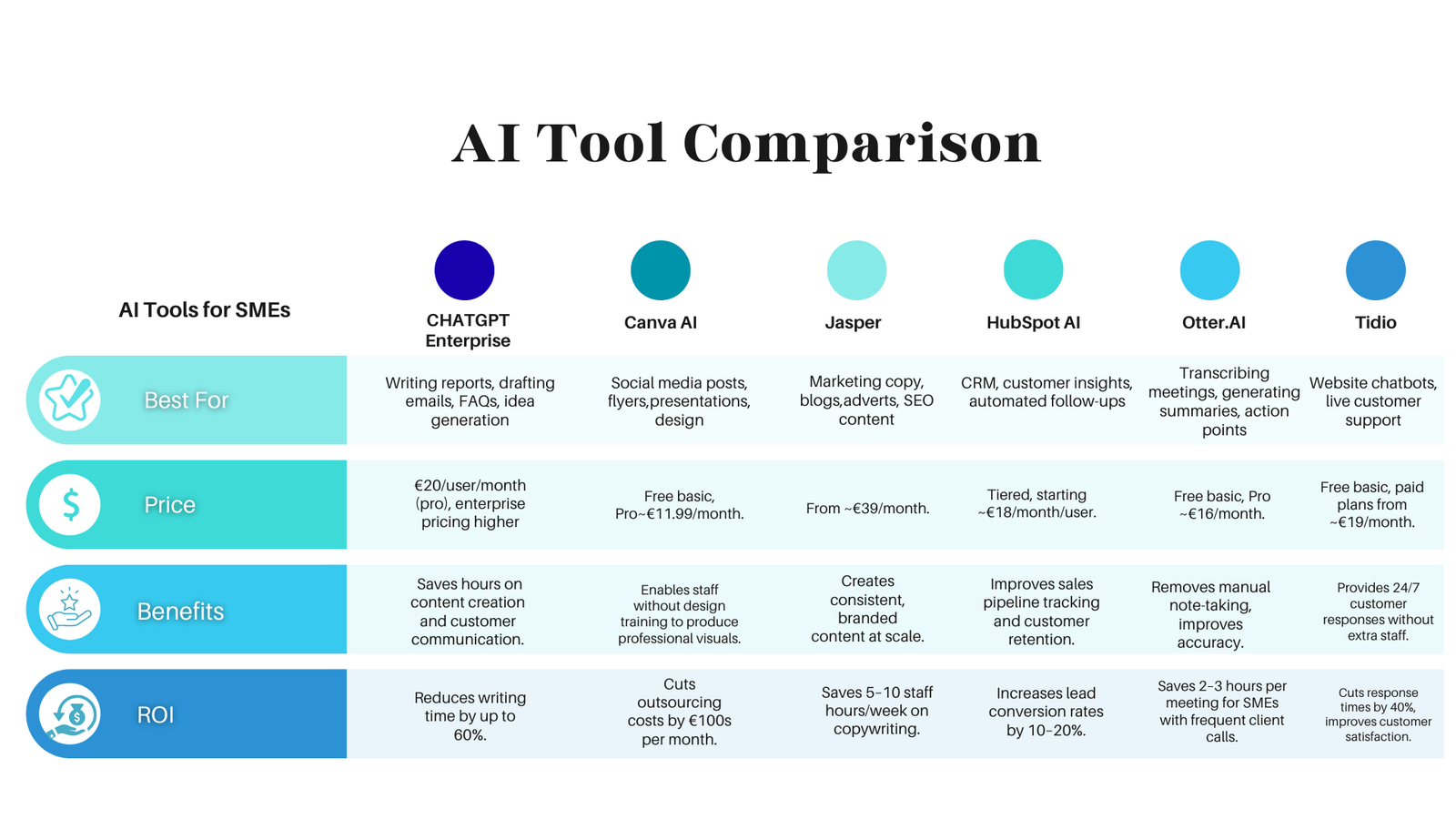
- Which of these tools do you think could save the most time in your business right now?
- If you could only try one tool this month, which would it be and why?
- Looking at the ROI row, which saving (time, cost, customer satisfaction) feels most valuable to your organisation?
- Do you already use any of these tools? If yes, how could you expand their use? If not, what’s stopping you?
- Which department in your company (marketing, HR, customer service, operations) would benefit most from one of these tools?
Risks
- Provider lock-in: If pricing rises, you may need alternatives.
- Data privacy: Always check GDPR compliance.
- Over-reliance: Use AI as an assistant, not a replacement for human judgment.
Unit 3 Recap
- The Taker Strategy allows SMEs to adopt AI quickly using ready-made tools.
- Benefits include low cost, ease of use, and fast results.
- Practical case studies show SMEs saving time and money across marketing, logistics, HR, and consulting.
- A simple checklist helps identify the right tool and avoid common risks.
Unit 4: Additional Resources
- OECD (2025). Emerging divides in the transition to artificial intelligence.
OECD report on how AI adoption differs across SMEs, with focus on opportunities and challenges.
https://www.oecd.org/en/publications/emerging-divides-in-the-transition-to-artificial-intelligence_7376c776-en.html - University of Manchester (2024). AI Catalyst: Cracking the code for MSME productivity.
Research project with case studies showing how SMEs pilot generative AI to improve productivity.
https://www.productivity.ac.uk/wp-content/uploads/2024/11/AI-Catalyst-Report-291124.pdf - European Commission – Digital Innovation Hubs (2024).
EU initiative providing support and funding pathways for SMEs adopting AI and digital technologies.https://digital-strategy.ec.europa.eu/en/policies/edihs - McKinsey & Company (2025). The State of AI: How Organizations Are Rewiring to Capture Value.
Global survey on AI adoption trends, generative AI growth, and business value creation.
https://www.mckinsey.com/capabilities/quantumblack/our-insights/the-state-of-ai - Tech Nation (2025). UK AI Sector Spotlight.
National-level insights on AI adoption, sector clusters, and SME impact.
https://technation.io/wp-content/uploads/2025/04/The-Tech-Nation-UK-AI-Sector-Spotlight-2025.pdf - World Economic Forum (2023). Empowering Small and Medium Enterprises (SMEs) for Innovation and Success
Research paper outlining challenges faced by SMEs, and recommendations for AI adoption. https://www3.weforum.org/docs/WEF_Data_Unleashed_Empowering_Small_and_Medium_Enterprises_(SMEs)_for_Innovation_and_Success_2023.pdf

Funded by the European Union. Views and opinions expressed are however those of the author(s) only and do not necessarily reflect those of the European Union or the European Education and Culture Executive Agency (EACEA). Neither the European Union nor EACEA can be held responsible for them. [Project number: 2024-1-AT01-KA220-VET-000245796]