

Introduction:
AI is becoming part of everyday decision-making in SMEs — from customer service and marketing to HR and operations. With this comes new responsibilities around fairness, transparency, data protection, and accountability. This module provides a practical introduction to ethical AI, helping SMEs understand the real-world risks, spot common red flags, and apply simple, responsible practices when using AI tools. The focus is on realistic actions businesses can take to ensure their use of AI remains safe, fair, and trustworthy.
Learning outcomes
By completing Module 5: Ethical AI for Business, learners will be able to:
- Understand key ethical concerns related to AI use in SMEs, including bias, transparency, privacy, and accountability.
- Identify common ethical risks in everyday AI tools such as chatbots, content generators, recruitment filters, and analytics dashboards.
- Apply practical strategies to reduce ethical, reputational, and legal risks in their own SME.
- Promote responsible, inclusive, and transparent AI adoption across business processes.
Units in this Module
Unit 1: Understanding Ethical AI — From Principles to Practice
Unit 2: AI Ethics Challenges Facing SMEs
Unit 3: Managing AI Ethically in Your Business
Unit 4: Additional Resources & Assessment
Unit 1 – Understanding Ethical AI: From Principles to Practice
Introduction
Ethical AI is not an abstract concept. It is the foundation for making artificial intelligence reliable, safe, and useful in real business contexts. SMEs often view AI as a technical tool, but every business decision involving AI has ethical consequences, whether in interactions with customers, relationships with employees or data management. This unit explores the meaning of ethical AI, as defined by international guidelines (UNESCO, EU), and why it should be an integral part of SMEs’ daily decision-making.
What does “Ethical AI” mean?
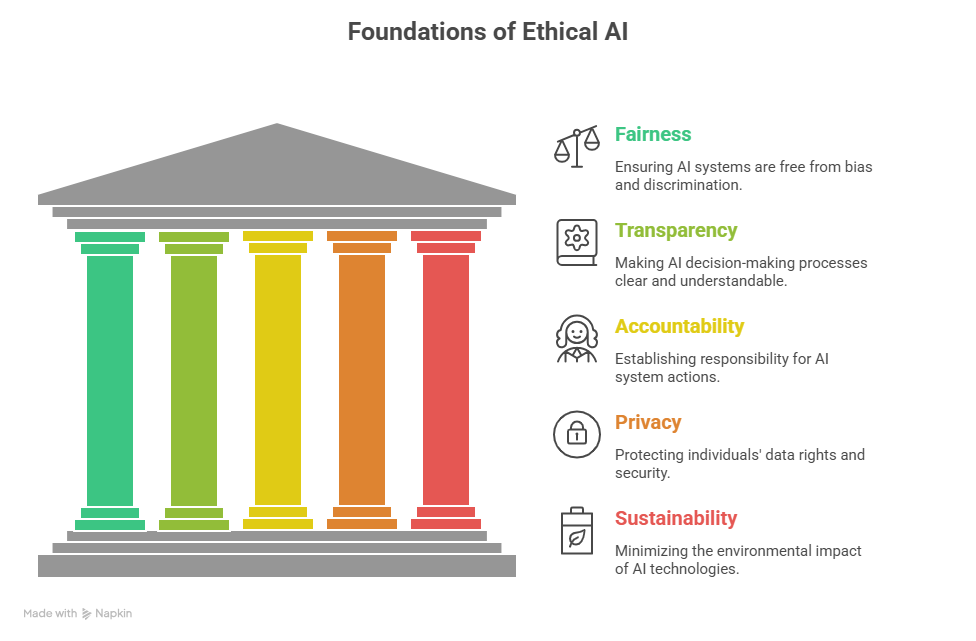
Ethical AI refers to the design and use of AI systems that respect values such as:
- fairness – avoiding bias and discrimination;
- transparency – making decisions understandable;
- accountability – clarifying who is responsible;
- privacy – protecting data rights;
- sustainability – reducing environmental impact.
Example: an AI tool that recommends candidates for a job should not unfairly exclude women or minority groups. A marketing chatbot should clearly disclose when users are interacting with AI and how their data will be used.
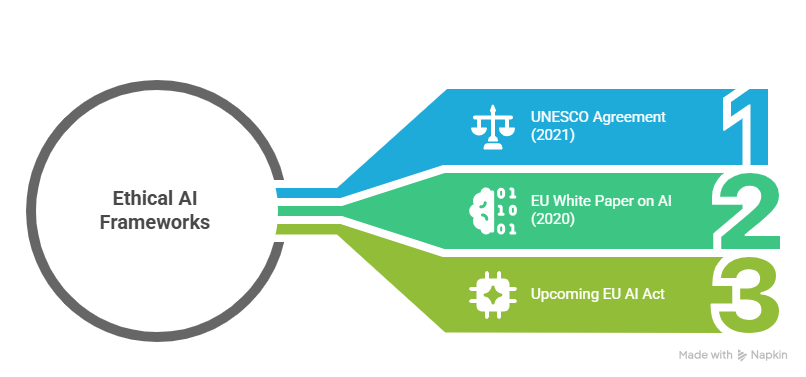
International frameworks shaping Ethical AI
- UNESCO (2021). First Global Agreement on the Ethics of AI, adopted by 193 Member States, stressing fairness, transparency, accountability, privacy, sustainability, and a ban on harmful practices like social credit scoring and mass surveillance.
- EU White Paper on AI (2020) . Introduced the dual idea of an ecosystem of excellence (innovation) and an ecosystem of trust (safety, ethics, legal compliance).
- Upcoming EU AI Act. Will introduce binding rules for “high-risk AI systems” and guidance for SMEs.
Why Ethical AI matters for SMEs
✔ Builds customer trust
People trust businesses that are transparent about how AI is used.
✔ Reduces complaints and legal risk
Bad AI decisions can violate GDPR or upcoming EU AI rules.
✔ Improves fairness in hiring, marketing, and communication
Poorly designed AI can exclude customers or candidates.
✔ Strengthens brand reputation
Ethical behaviour creates competitive advantage.
Everyday Ethical AI in SMEs
Ethical AI is not abstract – it affects simple, daily operations.
Example A: Chatbots
- Must disclose they are AI
- Should offer a human handover option
- Should respect user consent before gathering data
Example B: Marketing AI
- Must avoid reinforcing stereotypes
- Should check wording for bias
- Must ensure data is used with permission
Example C: Recruitment Tools
- AI can help shortlist, but humans must review
- Criteria should be job-related, not demographic
- AI suggestions should be explainable
Example D: Customer Insights Dashboards
- Data must be anonymised
- Predictions must be verified
- Employees should understand what the dashboard is — and isn’t — saying
Ethical Awareness Check
Reflect on your own SME, and tick any that apply:
We disclose when customers interact with a chatbot | |
AI-generated content is always reviewed by a human | |
We avoid uploading sensitive or personal data into public AI tools | |
We have an assigned person responsible for AI oversight | |
Staff understand the limits of the AI tools they use |
Red Flags to Watch For
These are signals that an AI tool may not be acting ethically:
🔴 The tool provides outcomes but no explanation
🔴 It requires unnecessary personal data
🔴 It behaves differently for similar users
🔴 Marketing or hiring results look suspiciously skewed
🔴 Staff feel pressure to accept AI outputs without questioning
🔴 The organisation hides where AI is being used
The Human Role in Ensuring Ethical AI
Even when AI is integrated into workflows, people remain accountable.
Humans are responsible for:
- setting boundaries and rules for AI use
- reviewing and approving AI outputs
- identifying and correcting harmful patterns
- communicating decisions to customers
- keeping data secure
- monitoring performance over time
AI supports — but humans decide.
Reflection
- Which ethical principle is most relevant to your SME right now?
- Where do you see the biggest ethical risk?
- What is one small improvement your SME could make tomorrow?
Unit 2 – AI Ethics Challenges Facing SMEs
Common Ethical Risks SMEs
AI can improve efficiency, decision-making, and customer service — but it also introduces risks that SMEs often overlook.
These risks are not theoretical: they show up in everyday tools like chatbots, automated ads, CV filters, and analytics dashboards.
This unit highlights the main ethical risks SMEs should understand and provides practical examples, red flags, and mitigation tips.
Ethical Risk 1: Bias & Discrimination
AI systems learn from data — and if the data contains bias, the AI will repeat it.
How this appears in real SME tools
- Recruitment filters score CVs lower because of age, gender, nationality, or names.
- Marketing AI targets ads mainly to a narrow demographic group.
- Chatbots misunderstand older customers or those with non-standard phrasing.
- Credit-scoring models downgrade clients from certain postal codes.
Why this matters
- Unfair outcomes
- Excluded customers
- Damage to reputation
- Potential legal consequences under equality and anti-discrimination laws
Red Flags (what to watch for)
- Recommendations heavily favour one group
- AI output “doesn’t feel right” but staff can’t explain why
- Very different results for similar cases
How SMEs can reduce bias
- Always use a human-in-the-loop for approvals
- Test tools with diverse examples
- Avoid feeding sensitive personal data into automated tools
- Choose vendors offering transparency about models and training data
Ethical Risk 2: Lack of Transparency
Many AI tools provide outcomes — but no explanation.
For SMEs, this creates confusion and mistrust.
Examples
- A loan-eligibility result appears with no reasoning.
- An AI assistant prioritises leads but staff don’t know why.
- A chatbot gives inconsistent answers and no one understands its logic.
Why it matters
- Staff cannot justify AI decisions to customers.
- SMEs may rely on decisions they can’t verify.
- Harder to detect mistakes or bias.
Red Flags
- The tool says: “Decision made. No explanation available.”
- Different team members get different outputs from the same prompt.
- The vendor cannot explain how the model works.
How SMEs can improve transparency
- Choose AI tools with “explainability” features
- Require vendors to answer: “What factors influence this model?”
- Provide simple customer-facing explanations
- Have a person responsible for reviewing AI-driven decisions
Ethical Risk 3: Privacy & Data Protection
AI tools often require access to data — sometimes more than SMEs realise.
Examples
- Uploading customer emails into public generative AI tools
- Marketing assistants storing user data without consent
- CRM AI models combining customer data with online behaviour
- Chatbots logging conversations indefinitely
Why it matters
- GDPR violations
- Loss of customer trust
- Data leaks or misuse
- Sensitive information ending up in model training
Red Flags
- AI tool requests unnecessary personal data
- Lack of clear privacy settings
- “We store your data to improve our models” with no further explanation
- No option to delete data
SME Mitigation Strategies
- Do not upload sensitive personal data into public AI systems
- Keep only data that is genuinely needed
- Use tools that allow data deletion and export
- Review privacy policies before adoption
Ethical Risk 4: Security & Model Vulnerability
Some AI systems can be manipulated or exploited.
Examples
- Chatbots responding to malicious prompts
- AI-generated emails used to impersonate employees
- Fraud detection tools bypassed using synthetic data
- “Jailbroken” prompts producing harmful outputs
Why it matters
- Security breaches
- Staff or customers receiving misleading information
- Reputational damage
- Regulatory exposure
Red Flags
- AI outputs unexpected or harmful instructions
- Lack of vendor security certifications
- No monitoring or update schedule
- AI accepts arbitrary inputs without restriction
What SMEs Can Do
- Provide staff guidelines on safe prompting
- Use tools with content moderation features
- Ask vendors how they protect against “model attacks”
- Regularly update or patch systems
Ethical Risk 5: Workforce & Organisational Impact
AI adoption can also affect employees — ethically and culturally.
Common issues
- Job insecurity or fear of replacement
- Confusion around responsibility
- Reduced trust if decisions feel “algorithmic” or opaque
- Over-reliance on automation
- Lack of AI oversight
What SMEs Should Prioritise
- Communicate openly: AI assists, humans decide
- Involve staff early in tool evaluation
- Provide training on new workflows
- Define clear human responsibilities
- Ensure staff can challenge AI outputs without fear
Exercise
Step 1 – Spot the Risk
Choose one AI tool your SME uses (or may use).
Identify one ethical risk and one mitigation.
Exercise B — Explain the Decision
Imagine an AI has classified a CV, flagged a risk, or recommended a product.
Write a 2–3 sentence explanation to a customer or colleague.
If it’s hard → this shows a transparency problem.
Exercise C — Data Check
List three types of data your SME collects.
Decide which are:
- essential
- optional
- unnecessary
This helps learners recognise privacy issues.
Summary: What SMEs Must Remember
- AI can amplify existing problems if unchecked
- Ethical risks often come from everyday tools, not advanced systems
- Bias, lack of transparency, and privacy issues are the most common pitfalls
- Humans remain responsible for decisions
- Ethics is not abstract — it builds trust and protects your business
The chart below lists the most common mistakes companies can make when using AI ethically and suggests some actions to mitigate the risk.
Common Mistake | Description | Mitigation Action |
Blind Trust in AI Outputs | Assuming AI-generated content or insights are always accurate without verification | Always fact-check and apply your own judgment before acting on AI results |
Lack of Transparency | Using AI tools or AI-generated content without disclosing it | Be transparent about when and how AI is used, especially in research, writing, or media |
Neglecting Data Privacy | Entering personal, confidential, or sensitive information into AI systems. | Treat AI systems as potentially public—never input data you wouldn’t share securely |
Bias and Fairness Blind Spots | Ignoring that AI models may reflect and amplify human biases | Watch for potential bias in datasets, training materials, and outputs, especially in hiring, legal, or healthcare contexts |
Misuse or Overuse of AI | Applying AI to decisions or contexts where it is not suitable | Always keep a human in the loop for sensitive, high-risk, or moral decisions |
Underestimating Legal and Reputational Risk | Failing to align AI use with regulations (GDPR, AI Act, labor laws) or public expectations | Regularly monitor compliance with regulations such as the EU AI Act and GDPR |
Ethical principles to remember while using AI:
- Responsibility: You are responsible for the results, not the tool.
- Fairness: Treat all users and stakeholders fairly and respectfully.
- Transparency: Be honest about the role and limitations of AI.
- Privacy: Protect data and obtain consent before use.
- Human oversight: Maintain human review and intervention at critical stages.
Unit 3: Managing AI ethically in your business
Introduction:
Knowing the risks of AI is not enough — SMEs need practical ways to manage those risks.
This unit gives learners simple, realistic methods to ensure that AI is used responsibly, safely, and transparently.
We focus on what SMEs can implement immediately, without technical expertise or large budgets.
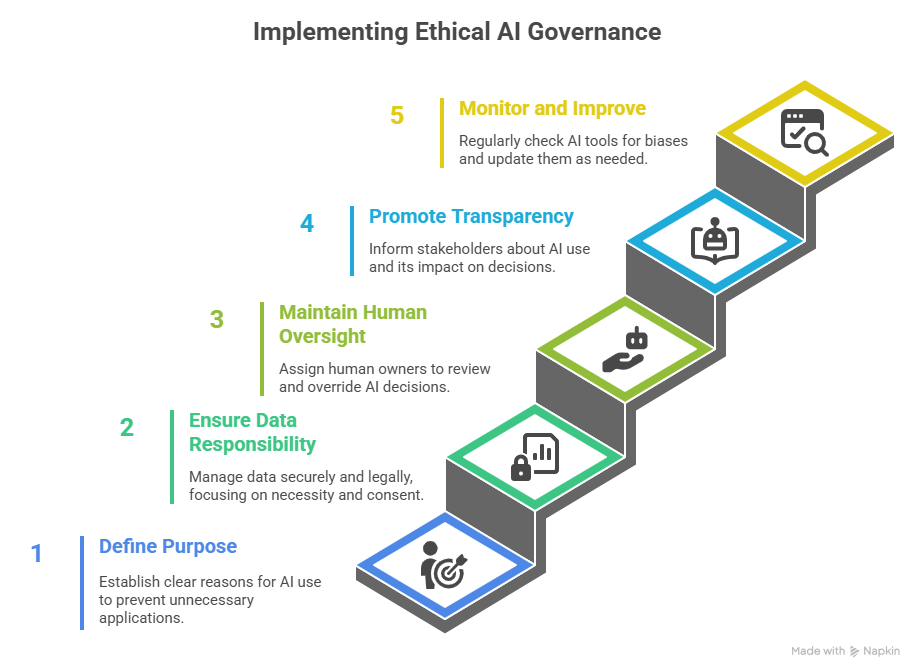
Ethical AI Governance for SMEs: A Simple Framework
But they can adopt a lightweight, effective framework based on five pillars:
Define why you are using AI.
- What problem are we solving?
- Is AI the right tool?
- Who benefits?
This prevents careless or unnecessary use of AI.
Ensure data is:
- minimal (only what you really need)
- secure
- collected legally (with consent, if required)
- stored safely
- accessible only to relevant staff
Ask:
“What data does this tool use, and do we actually need all of it?”
Every AI-supported task must have a human owner.
A person should:
- review important outputs
- override incorrect decisions
- answer customer questions
- approve AI-generated content
- monitor system behaviour
AI supports; humans decide.
People deserve to know:
- when AI is used
- what role it plays
- who is responsible for decisions
SMEs should:
- tell customers when they are interacting with a chatbot
- explain major AI-supported decisions in plain language
- document how tools influence workflows
AI tools must be checked regularly.
This includes:
- spot-checking outputs
- testing for inconsistent or biased results
- reviewing customer feedback
- ensuring tools are updated
- removing tools that no longer serve the business purpose
A simple monthly check-in is enough for many SMEs.
Practical Do’s & Dont’s for Ethical AI Use
DO
- Use AI to support—not replace—human decision-making
- Review AI content for tone, accuracy, and fairness
- Keep a record of how AI tools are used in workflows
- Train staff on limitations and safe usage
- Ensure customer data is stored securely
- Ask vendors to explain how their systems make decisions
DON’T
- Upload customer or employee sensitive data into public AI tools
- Allow AI tools to make final hiring, financial, or disciplinary decisions
- Rely on AI-generated text without human verification
- Collect more data than is necessary
- Hide AI use from customers or staff
- Ignore unusual or inconsistent AI outputs
How SMEs Can Apply Ethical Principles
Scenario 1 — Recruitment Tool
An AI screening tool consistently ranks younger candidates higher.
Ethical Response:
- Audit the criteria being used
- Re-balance training data or adjust filters
- Require a human to review all CVs
- Document final hiring decisions manually
Scenario 2 — Marketing Content Generator
A generative AI tool produces ad text that unintentionally stereotypes certain groups.
Ethical Response:
- Review AI-generated content before publishing
- Remove biased language
- Train the model with better examples (if available)
- Have two-person approval for sensitive campaigns
Scenario 3 — Customer Support Chatbot
The chatbot struggles with certain accents and routes calls incorrectly.
Ethical Response:
- Improve example phrases used for training
- Add a fast “Talk to a human” option
- Track incorrect classifications for monitoring
- Provide staff with weekly summaries of issues encountered
Scenario 4 — Sales Forecasting Tool
An AI model predicts lower demand but staff know about upcoming events not captured in the data.
Ethical Response:
- Compare AI outputs with human knowledge
- Adjust the forecast manually
- Add contextual notes (e.g., planned promotions, local events)
- Use AI as a starting point, not a final answer
Simple SME Tools for Ethical AI Management
SMEs can use lightweight methods to ensure responsible use:
1. An “AI Use Register”
A simple spreadsheet listing:
- each AI tool
- what it does
- what data it uses
- who is responsible
- known risks
- how often it is reviewed
2. A Monthly AI Check-In
One 30-minute session to:
- review issues
- test outputs
- check for unusual behaviour
- evaluate whether the tool is still needed
3. A Human Review Checklist
Before publishing or approving AI output:
- Is the information accurate?
- Is it fair and inclusive?
- Does it respect privacy?
- Could a customer misinterpret it?
Do we understand why the AI made this suggestion?
4. Internal Quick Guides
Short, easy-to-read instructions for:
- when and how staff can use AI
- what data they may or may not upload
- how to escalate issues
Exercise
Choose an AI tool your SME uses. Identify:
- One ethical risk
- One transparency improvement you could add
- One oversight step
- One customer communication step
Unit 4: Additional Resources
1. AlgorithmWatch
A non-profit that monitors how automated systems impact society.
They focus on transparency, explainability, and accountability in algorithms.
https://algorithmwatch.org/en/
2. AI Now Institute (New York University)
Researches the social implications of AI, including fairness, discrimination, and public accountability.
Their reports are written in accessible language — ideal for SMEs.
https://ainowinstitute.org/
3. DARPA – Explainable AI (XAI Program)
The U.S. Defence Advanced Research Projects Agency leads global work on explainable AI — AI systems that show why they make decisions.
Their materials are useful for understanding transparency standards.
https://www.darpa.mil/program/explainable-artificial-intelligence
4. CHAI – Centre for Human-Compatible AI (UC Berkeley)
Focuses on ensuring AI systems remain beneficial, trustworthy, and aligned with human values.
Their resources help SMEs understand long-term risks and safe system design.
https://humancompatible.ai/
5. NSCAI – National Security Commission on Artificial Intelligence
An independent U.S. commission that examines how AI impacts national security and responsible innovation.
Useful for high-level ethical standards and policy insights.
https://www.nscai.gov/
Scenario Task: Evaluating AI Use in an SME
Scenario
A mid-sized retail SME has recently introduced several AI tools:
- a chatbot handling customer queries
- an AI assistant generating marketing content
- an automated tool screening CVs
- a demand-forecasting dashboard used by the store manager
Over the past month, staff have reported issues:
- customers are frustrated when the chatbot gives incorrect answers
- marketing posts include wording that feels stereotypical
- CV filtering appears to favour younger candidates
- forecasts do not account for local events, confusing staff
- employees are unsure who is responsible for reviewing AI outputs
Your Task
Write a short response (8–12 sentences) addressing the following:
- Identify three ethical risks present in the scenario
(e.g., bias, lack of transparency, poor oversight, privacy concerns). - Explain why each risk matters for customers or employees.
- Propose one realistic solution for each risk, using the frameworks from Units 1–3
(e.g., human-in-the-loop checks, transparency statements, improved data practices, monthly reviews). - Describe who should be responsible for monitoring the AI tools.
You may respond in paragraph format or as a table.

Funded by the European Union. Views and opinions expressed are however those of the author(s) only and do not necessarily reflect those of the European Union or the European Education and Culture Executive Agency (EACEA). Neither the European Union nor EACEA can be held responsible for them. [Project number: 2024-1-AT01-KA220-VET-000245796]