

Module 6 - Leadership & Innovation Culture

Introduction:

Artificial Intelligence is changing how SMEs work, make decisions, and innovate — but successful adoption depends far more on leadership and culture than on technology. This module explores the behaviours, mindsets, and organisational conditions that enable teams to use AI confidently and effectively. Learners will examine what good AI leadership looks like, how to build an innovation-friendly culture, and how to guide staff through continuous digital change. The focus is practical: real SME scenarios, simple models, and clear actions leaders can take to support responsible, confident AI use.

Learning outcomes

By completing Module 6: Leadership & Innovation Culture, you will be able to:

  • Recognise leadership mindsets and behaviours that support AI adoption.
  • Explain how organisational culture influences the success of AI implementation.
  • Identify practical steps to strengthen innovation culture within an SME.
  • Apply leadership strategies that reduce resistance, improve coordination, and support staff during AI-driven changes.
  • Reflect on your own leadership readiness and how you can contribute to responsible AI use.

Units in this Module

Unit 1: AI Leadership Mindset
Unit 2: Fostering an Innovation Culture
Unit 3: Leading Change Through AI Adoption
Unit 4: Additional Resources

Unit 1 – AI Leadership Mindset

What is Leadership in the Context of AI?

AI leadership does not mean being an expert in machine learning. It means the ability to:

  • guide people through digital change
  • make decisions that combine human judgement + AI insights
  • create the conditions for experimentation
  • support staff in developing new skills
  • communicate the purpose and value of new tools

Good AI leadership is about behaviour, not technical skill.

Why do AI Projects Fail?

AI projects fail in SMEs not because of the technology, but because:

  • leaders underestimate the human and organisational demands,
  • teams struggle with cognitive overload,
  • departments adopt AI in silos,
  • and organisations lack a structured implementation plan.

According to the AI Implementation Leadership Framework (gigCMO, 2025), 95% of AI projects fail to move beyond pilots, but SMEs that develop strong leadership capacity achieve ROI within 3–12 months. 

Key Message: AI leadership is not “IT leadership” – it is organisational leadership involving people, processes, and systems.

The AI Implementation Leadership Framework

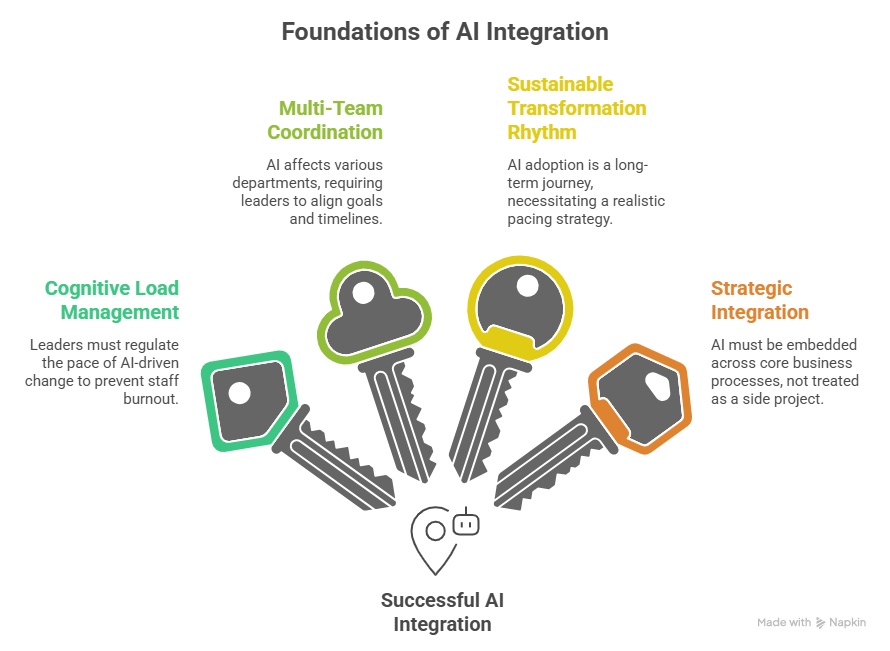
This model identifies four leadership pillars that determine whether an SME successfully integrates AI:

Leaders must regulate the pace of AI-driven change so staff can absorb it without burnout.

What this means in practice:

  • Break AI adoption into manageable phases.
  • Avoid “AI overload” where too many tools are introduced at once.
  • Monitor the gap between AI-generated speed and human execution speed.

Experienced developers report productivity drops of 19% during initial AI adoption because cognitive load spikes temporarily.

AI affects marketing, finance, operations, HR, customer service, compliance.
Leaders must manage multiple teams with different needs and capacities.

What this means in practice:

  • AI adoption creates cross-department interdependencies.
  • Leadership must align goals and timelines across teams.
  • AI outputs must feed into each department smoothly.

AI adoption isn’t a 2-week project — it’s a 12–18 month journey.
Leaders must set a realistic pacing strategy.

What this means in practice:

  • Avoid rushing from “pilot” to “full rollout”.
  • Build a monthly rhythm for experimentation, training, and review.

Protect time for staff to learn and adapt.

The final pillar ensures AI is not a “side project”, but embedded across core business processes.

Examples:

  • AI-driven forecasting used in weekly planning.
  • AI-generated insights included in management meetings.
  • AI automations integrated into customer workflows.

Organisations that achieve strategic integration reduce repetitive work by 86% within 3–4 months and cut processing costs by 80%. 
 

What SME Leaders Must Prioritise

Using the framework, leaders should focus on:

✔

Teams need:

  • digital literacy
  • data interpretation skills
  • adaptability
  • decision-making using AI outputs


✔
  • clean, structured data
  • interoperable systems
  • documented processes
✔
  • openness to experimentation
  • psychological safety for learning
  • leadership modelling AI use
  • Based on the framework’s findings: 
  • Moving too fast without managing cognitive load
  • Treating AI as solely an IT responsibility
  • Underestimating the training burden
  • No clear ownership or project rhythm
  • Not coordinating between departments
  • Expecting “plug and play” AI adoption
  • Lack of transparency about data usage

Reflection 


1. How does AI adoption currently fit into your organisation’s overall strategy?

Does it feel reactive (tool-by-tool) or intentional (linked to business goals)?

2. What leadership behaviours have you already observed in AI-related decisions?

For example: curiosity, hesitation, over-reliance on tech, lack of coordination, or strong support.

3. Which part of your organisation appears most ready for AI—and which part seems most resistant?

Why might that be?

4. What pressures or constraints (time, budget, skills, culture) could slow AI adoption in your SME?

How might leadership address one of these constraints?

5. What is your role in supporting responsible AI use in your organisation?

Consider communication, peer support, policy awareness, or modelling good behaviour.

Unit 2 – Fostering an Innovation Culture

What is Innovation Culture?

Innovation culture is how people think, work, and interact to improve processes, products, or services.

An organisation has strong innovation culture when:

  • staff feel safe experimenting
  • mistakes are learning opportunities
  • collaboration is encouraged
  • leadership trusts staff to try things
  • new ideas are welcomed
  • digital tools are easy to adopt
  • change is normal, not threatening

When adopting AI tools, these cultural elements matter even more — staff must trust the technology, feel supported during change, and understand their role in making decisions informed by AI.

Cultural Factors That Enable Innovation

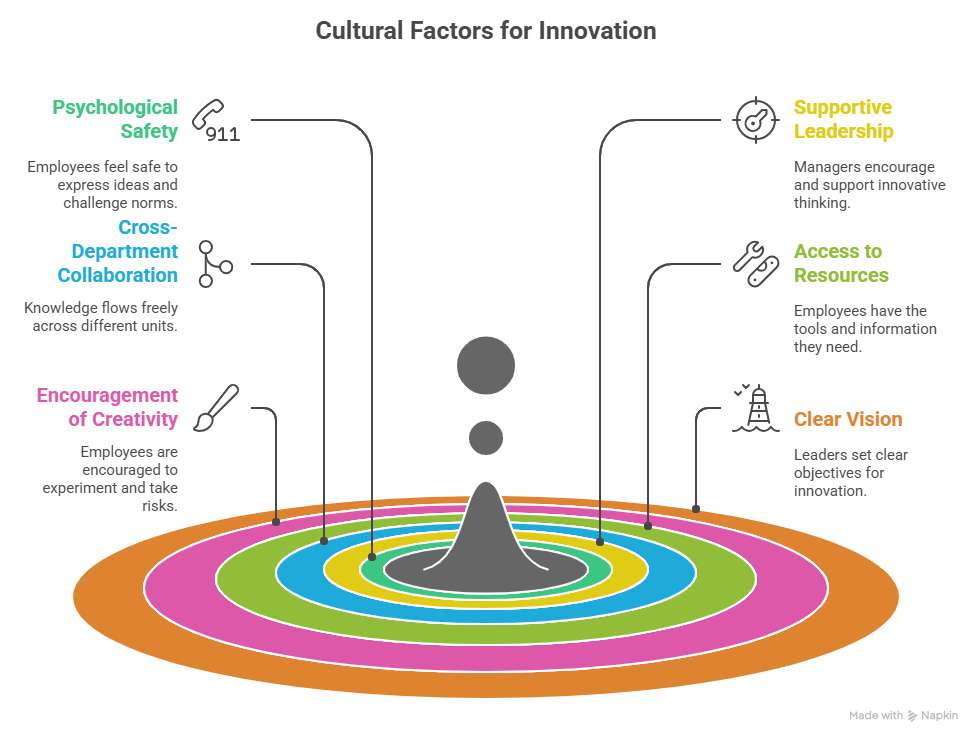
According to findings of research conducted in Poland, SMEs with strong innovation cultures share several characteristics. 

Employees feel safe to express ideas, question decisions, and propose improvements — even when they challenge the status quo.

  • Employees can question superiors' ideas.
  • People who speak up are valued.
  • Different viewpoints are encouraged.

This directly supports AI adoption: staff must feel safe reporting errors, voicing uncertainty, and suggesting improvements.

Managers play a pivotal role. Research shows managers are responsible for:

  • stimulating employees’ innovative thinking
  • planning and initiating innovation processes
  • organising and overseeing implementation
  • motivating others to be creative

In AI adoption, managers must communicate why AI is being used and support staff who feel insecure or overwhelmed.

Employees across units collaborate formally and informally.
Knowledge moves freely across the organisation.

This is essential when AI tools influence multiple workflows (e.g., marketing + customer service + operations).

Employees feel they have:

  • the right tools
  • access to information
  • supportive work environments

If staff struggle with equipment or lack basic training, AI adoption fails quickly.

Employees are encouraged to try new approaches, even if they fail.
Innovation cultures:

  • reward initiative
  • accept mistakes as part of learning
  • avoid excessive bureaucracy and rigid procedures

AI adoption always involves trial-and-error; staff must feel able to experiment.

Leaders reinforce that innovation is desirable by setting clear objectives.
Employees understand the mission and how innovation helps achieve it.

During AI adoption, linking AI to goals (better customer service, less admin time, improved decision-making) reduces resistance.
 

Barriers That Block Innovation Culture

The research identifies several barriers that undermine innovation efforts — these are common in SMEs beginning their AI journey:

  • Excessive formalisation or bureaucracy
    (slows decision-making and kills creativity)
  • High employee fear of change or job loss
  • Lack of communication about benefits
  • Little cross-team collaboration
  • Managers who do not model innovative behaviour

AI adoption often triggers the same fears (e.g., “AI will replace me”), so these barriers must be proactively addressed.

What an Innovation Culture Looks Like in Practice

Example 1 – A Retail Store Using AI Recommendations

Employees are encouraged to test AI-generated product suggestions and share customer reactions. Managers reassure staff that AI supports their knowledge, not replaces it.

Example 2 – A Services SME Implementing AI Support Tickets

Teams across customer service and operations meet weekly to discuss AI-generated insights. Staff report errors without fear, and leadership adjusts workflows accordingly.

Example 3 – A Manufacturing SME Using Predictive Maintenance Dashboards

Operators receive basic training and are encouraged to propose improvements to how insights are displayed or used in scheduling.

Culture Snapshot Assessment 

Reflect on your organisation’s current culture using these prompts derived from the research in Poland:

Rate your organisation from 1–5 on the following:

  • Employees feel safe to suggest ideas or question decisions.
  • Managers openly support experimentation.
  • Teams collaborate across departments.
  • Mistakes are treated as learning opportunities.
  • Information and knowledge flow freely.
  • Staff have resources and tools to try new methods.
  • Employees understand the company’s innovation goals.

Reflection Questions

  • Which cultural strengths support AI adoption today?
  • Which cultural barriers need attention?
  • What one change in leadership behaviour would have the biggest positive impact?

Unit 3: Leading Change through AI Adoption

Introduction:

AI adoption is not a technical project — it is an organisational transformation.
In SMEs, where roles often overlap and resources are limited, leadership plays an even bigger role in determining whether AI implementation succeeds, stalls, or fails.

This unit translates evidence-based principles from the AI implementation leadership framework into clear, SME-friendly practices. The goal is to help leaders and staff understand what effective AI leadership looks like during change.

What Makes AI Adoption Different From Other Digital Changes?


Research from the linked article shows that AI adoption places unusual demand on organisations:

  • Workflows change quickly.
  • Staff face continuous cognitive strain (new interfaces, recommendations, alerts).
  • AI tools transform how decisions are made.
  • Teams must coordinate — siloed work breaks the process.
  • Learning must be ongoing, not one-off.

This means AI requires a different leadership approach than past IT upgrades.

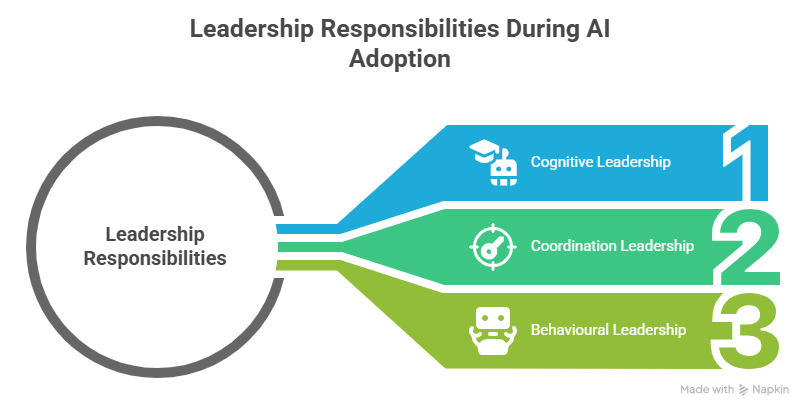
Three Leadership Responsibilities During AI Adoption

Based on the framework introduced in the previous article, SMEs need leaders who can manage three parallel responsibilities:

AI tools generate constant information: predictions, alerts, anomalies, insights.
Employees often feel overwhelmed.

Leaders support adoption by:

  • simplifying what staff should pay attention to
  • translating AI outputs into clear priorities
  • avoiding information overload
  • giving staff time to practise new workflows
  • reassuring teams when uncertainty rises


Example:
Instead of giving teams full dashboards from day one, a manager identifies three KPIs AI will help improve and starts there.

This directly mirrors the article’s finding that AI requires leaders to “buffer cognitive strain and direct attention towards the most valuable tasks.”

AI adoption cuts across teams.
Marketing, operations, finance, HR, and customer service often all feel the impact.

Leaders need to:

  • ensure teams share insights, not work in silos
  • redesign workflows to include AI-generated recommendations
  • agree on who makes final decisions
  • clarify roles so staff understand how AI fits into their job
  • create cross-team “AI checkpoints” or regular review meetings


The article emphasises that implementation requires “multi-team coordination to sustain new practices and integrate them into operations.”

Example:
A retail SME introduces AI demand forecasting.
Inventory, purchasing, and sales now meet weekly to review predictions and align stock orders.

People watch leaders to decide how they should feel about AI.

Leaders must demonstrate:

  • curiosity rather than fear
  • openness to trying new tools
  • willingness to learn alongside staff
  • transparency about goals and expectations
  • patience during mistakes and early errors
  • commitment to responsible use

This is consistent with the article’s finding that effective implementation requires “leaders modelling new behaviours and encouraging collective sense-making.”

Example:
Managers show that it’s okay not to know.
They complete training exercises with staff, not above them.

 

How Leaders Can Sustain Adoption Over Time 

The previous article emphasises that AI implementation is never finished. New tools, updates, features, and workflow adjustments continue evolving. Leaders must therefore:

✔ Maintain regular communication

Explain:

  • what the AI tool is doing
  • why it matters
  • what staff should expect next

✔ Reinforce habits

AI insights must be used consistently to build routine.

✔ Provide ongoing training

Short micro-lessons, refreshers, peer coaching, and practice loops.

✔ Create feedback loops

Ask staff:

  • What’s confusing?
  • What takes too long?
  • What would help?

✔ Adjust tools as roles change

As teams get confident, leaders introduce more advanced features.

All of these behaviours match the article’s description of sustaining transformations by “supporting continuous learning, feedback, and adaptation across teams.”

Leadership in Practice - Scenario Reflection

Scenario 1 — Confusing AI Outputs

A team receives predictions from a new AI tool, but nobody is sure which ones matter most. Staff feel overloaded and begin ignoring the dashboard alerts.

Scenario 2 — Workflow Conflict

AI-generated recommendations require coordination between sales and operations, but each team claims the other is responsible for follow-up actions.

Scenario 3 — Resistance from a Senior Employee

A long-serving employee quietly discourages others from using the AI assistant, saying “It won’t work in the real world — it’s just a gimmick.”

Reflection Questions (choose any three)


  1. Which scenario feels most realistic in your SME and why?
    (Think of workflows, people dynamics, communication habits.)
  2. In Scenario 1, what is the first leadership action you would take to reduce the cognitive overload?
    • Clarify priorities?
    • Provide a simplified view?
    • Offer micro-training?
    • Something else?


  3. In Scenario 2, what coordination mechanism would you put in place so responsibilities are clear?
    • A weekly meeting?
    • A shared checklist?
    • Defined “trigger–action” rules?


  4. In Scenario 3, how would you handle the resistant employee without creating tension?
    Consider: conversation style, reassurance, examples, training.


  5. What leadership behaviour (communication, modelling, feedback, transparency) would have prevented these situations early on?


  6. If you were leading an AI rollout next month, what is one thing you would do differently based on these scenarios?

Unit 4: Additional Resources

McKinsey Playbook for a Successful AI Transformation

Clear explanation of how leaders guide AI adoption, manage expectations, and restructure workflows.
https://ai-partner.fr/en/offre/conseil-strategie/mckinsey-playbook-for-a-successful-ai-transformation

Harvard Business Review – “Reskilling in the Age of AI”

Explores how managers support employees during transitions and reduce fear of automation.
https://hbr.org/2023/09/reskilling-in-the-age-of-ai

OECD – “Leadership for a Digital and Green Transformation” (2023)

Practical insights on leadership behaviours that enable innovation in SMEs.
https://www.oecd.org/en/topics/digital-transformation.html

World Economic Forum – “AI is changing the shape of leadership – how can business leaders prepare?

Leadership in the age of AI, and how businesses can prepare

https://www.weforum.org/stories/2024/05/ai-is-changing-the-shape-of-leadership-how-can-business-leaders-prepare/

Self-Reflection Assessment

Reflect on the following five questions. Your answers help you understand your readiness to support AI adoption in your organisation.

1. How do you usually react to new technologies at work?

(e.g., curious, hesitant, overwhelmed, motivated)

2. What is the biggest leadership challenge you foresee with AI adoption?

Choose one:

  • helping people manage change

  • coordinating teams and workflows

  • communicating clearly about expectations

  • modelling positive attitudes

  • supporting staff who feel unsure

3. Which aspect of your organisation’s culture will help AI adoption the most?

(e.g., openness, teamwork, trust, supportive managers)


4. Which aspect of the culture could slow AI adoption?

(e.g., fear of mistakes, resistance to change, poor communication)


5. What is one practical action you personally commit to taking in the next month to support AI adoption?

References

Funded by the European Union. Views and opinions expressed are however those of the author(s) only and do not necessarily reflect those of the European Union or the European Education and Culture Executive Agency (EACEA). Neither the European Union nor EACEA can be held responsible for them. [Project number: 2024-1-AT01-KA220-VET-000245796]

Scroll to Top