
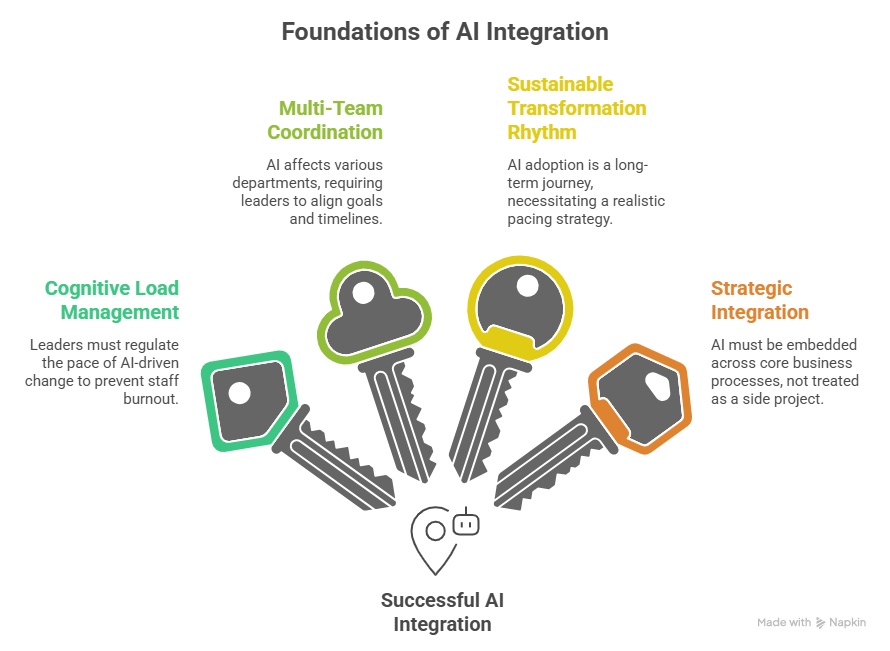
Leaders must regulate the pace of AI-driven change so staff can absorb it without burnout.
What this means in practice:
- Break AI adoption into manageable phases.
- Avoid “AI overload” where too many tools are introduced at once.
- Monitor the gap between AI-generated speed and human execution speed.
Experienced developers report productivity drops of 19% during initial AI adoption because cognitive load spikes temporarily.
AI affects marketing, finance, operations, HR, customer service, compliance.
Leaders must manage multiple teams with different needs and capacities.
What this means in practice:
- AI adoption creates cross-department interdependencies.
- Leadership must align goals and timelines across teams.
- AI outputs must feed into each department smoothly.
AI adoption isn’t a 2-week project — it’s a 12–18 month journey.
Leaders must set a realistic pacing strategy.
What this means in practice:
- Avoid rushing from “pilot” to “full rollout”.
- Build a monthly rhythm for experimentation, training, and review.
Protect time for staff to learn and adapt.
The final pillar ensures AI is not a “side project”, but embedded across core business processes.
Examples:
- AI-driven forecasting used in weekly planning.
- AI-generated insights included in management meetings.
- AI automations integrated into customer workflows.
Organisations that achieve strategic integration reduce repetitive work by 86% within 3–4 months and cut processing costs by 80%.
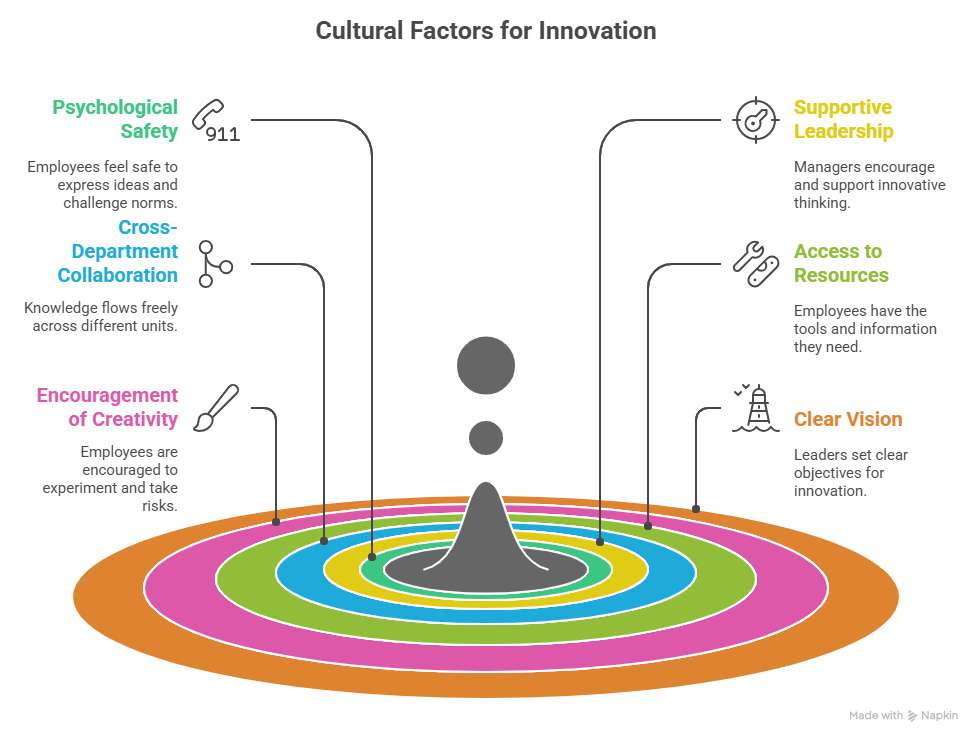
Employees feel safe to express ideas, question decisions, and propose improvements — even when they challenge the status quo.
- Employees can question superiors' ideas.
- People who speak up are valued.
- Different viewpoints are encouraged.
This directly supports AI adoption: staff must feel safe reporting errors, voicing uncertainty, and suggesting improvements.
Managers play a pivotal role. Research shows managers are responsible for:
- stimulating employees’ innovative thinking
- planning and initiating innovation processes
- organising and overseeing implementation
- motivating others to be creative
In AI adoption, managers must communicate why AI is being used and support staff who feel insecure or overwhelmed.
Employees across units collaborate formally and informally.
Knowledge moves freely across the organisation.
This is essential when AI tools influence multiple workflows (e.g., marketing + customer service + operations).
Employees feel they have:
- the right tools
- access to information
- supportive work environments
If staff struggle with equipment or lack basic training, AI adoption fails quickly.
Employees are encouraged to try new approaches, even if they fail.
Innovation cultures:
- reward initiative
- accept mistakes as part of learning
- avoid excessive bureaucracy and rigid procedures
AI adoption always involves trial-and-error; staff must feel able to experiment.
Leaders reinforce that innovation is desirable by setting clear objectives.
Employees understand the mission and how innovation helps achieve it.
During AI adoption, linking AI to goals (better customer service, less admin time, improved decision-making) reduces resistance.
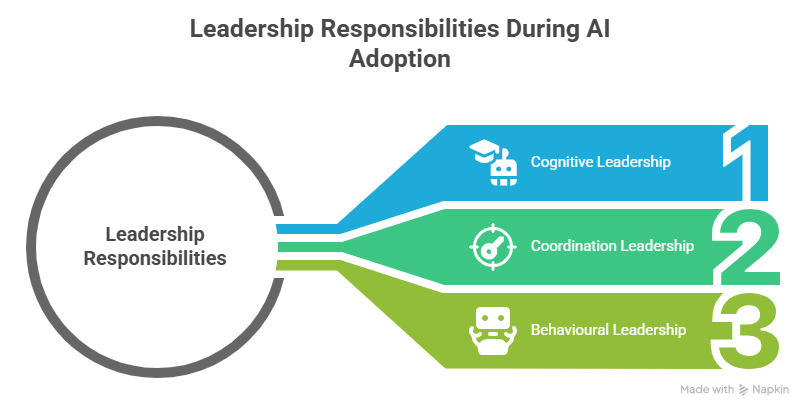
AI tools generate constant information: predictions, alerts, anomalies, insights.
Employees often feel overwhelmed.
Leaders support adoption by:
- simplifying what staff should pay attention to
- translating AI outputs into clear priorities
- avoiding information overload
- giving staff time to practise new workflows
- reassuring teams when uncertainty rises
Example:
Instead of giving teams full dashboards from day one, a manager identifies three KPIs AI will help improve and starts there.
This directly mirrors the article’s finding that AI requires leaders to “buffer cognitive strain and direct attention towards the most valuable tasks.”
AI adoption cuts across teams.
Marketing, operations, finance, HR, and customer service often all feel the impact.
Leaders need to:
- ensure teams share insights, not work in silos
- redesign workflows to include AI-generated recommendations
- agree on who makes final decisions
- clarify roles so staff understand how AI fits into their job
- create cross-team “AI checkpoints” or regular review meetings
The article emphasises that implementation requires “multi-team coordination to sustain new practices and integrate them into operations.”
Example:
A retail SME introduces AI demand forecasting.
Inventory, purchasing, and sales now meet weekly to review predictions and align stock orders.
People watch leaders to decide how they should feel about AI.
Leaders must demonstrate:
- curiosity rather than fear
- openness to trying new tools
- willingness to learn alongside staff
- transparency about goals and expectations
- patience during mistakes and early errors
- commitment to responsible use
This is consistent with the article’s finding that effective implementation requires “leaders modelling new behaviours and encouraging collective sense-making.”
Example:
Managers show that it’s okay not to know.
They complete training exercises with staff, not above them.