
Introduction:
Artificial Intelligence (AI) is transforming business operations, impacting how SMEs operate and the skills their workforce needs. This module introduces the changes in roles, tasks, and organisational structures, helping SMEs anticipate workforce skill requirements and plan for upskilling and adaptation.
Learning outcomes
By completing this module you will be able to:
- Describe how AI is transforming the workforce and workplace.
- Identify opportunities and risks AI brings to SMEs.
- Explain new roles and tasks emerging from AI adoption.
- Recognise the importance of adaptability and continuous learning.
- Apply examples of AI-driven workforce change to your own business context.
Units in this Module
Unit 1 – AI and the Changing Workforce
Introduction
Artificial Intelligence (AI) is actively reshaping SMEs today, changing how employees work, what skills are required, and how businesses make decisions. This unit explores the impact of AI on workforce tasks, evolving roles, and Human-AI collaboration.
Understanding Workforce Transformation
AI adoption is transforming the nature of work in SMEs. Many repetitive, rule-based, and data-intensive tasks—like scheduling, generating reports, processing invoices, or handling standard customer queries—can now be automated.
- Why this matters: Automation frees employees from routine work, allowing them to focus on strategic thinking, creativity, and problem-solving, skills that machines cannot replicate.
- Practical implications: For example, a small accounting team may spend hours reconciling invoices. With AI, the system processes entries, flags discrepancies, and generates reports. Staff can instead focus on identifying financial trends, forecasting cash flow, and advising management.
Reflection: Consider your SME: Which tasks are repetitive or time-consuming? How could AI free up time for higher-value work?
Evolving Job Roles in SMEs
Across SMEs, we already see roles shifting:
Employees become “supervisors” of AI outputs
Instead of producing every draft themselves, workers now:
- review AI suggestions
- quality-check text or analysis
- correct inaccuracies
- decide what to use or ignore
Work becomes more analytical and interpretive
Even non-technical employees increasingly:
- read dashboards
- interpret AI-generated insights
- make decisions based on patterns
Soft skills rise in importance
Because AI takes over routine work, humans add value through:
- communication
- problem-solving
- contextual thinking
- relationship-building
Examples from SME Contexts
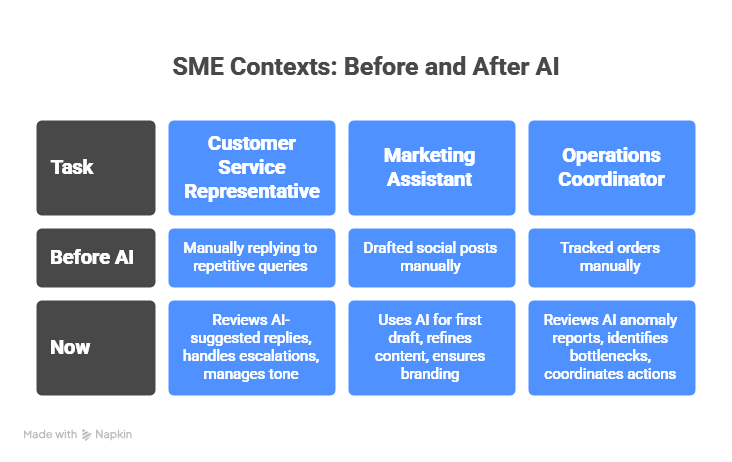
Customer Service Representative
Before AI: manually replying to repetitive queries
Now:
- reviews AI-suggested replies
- handles escalations
- manages tone and customer relationship
Marketing Assistant
Before AI: drafted social posts manually
Now:
- uses AI for first draft
- refines content
- ensures branding accuracy
- checks campaign performance
Operations Coordinator
Before AI: tracked orders manually
Now:
- reviews AI anomaly reports
- identifies bottlenecks flagged by AI
- coordinates actions between teams
Human-AI Collaboration in Daily Work
AI is a tool, not a decision-maker.
Effective SME employees learn to:
- Check the AI’s work
- Add context AI doesn’t know
- Make decisions, not just observe insights
This blend — AI output + human judgement — defines how work is changing now.
Video
To further your learning on this topic, watch the following video to learn more:
How AI Is Set to Reshape the Workplace: https://www.youtube.com/watch?v=orSE9g9lHLo
Reflection
- Which tasks in your role could AI assist with today?
- Which parts of your job require human judgement and should stay with you?
- What do you currently double-check before sending or approving?
References
- Brynjolfsson, E. & McAfee, A. (2017). Machine, Platform, Crowd: Harnessing Our Digital Future. W.W. Norton & Company.
- Deloitte Insights (2021). AI in the Workforce: Opportunities and Challenges.
- LinkedIn Learning. AI for Business Leaders.
Unit 2 – Understanding Future Skills Trends
Human-AI Collaboration and Future Skills
Based on WEF, OECD, McKinsey and SkillsNet projections, critical future skills for SMEs include:
1. Digital & Data Literacy
Not coding — but the ability to:
- read dashboards
- interpret insights
- understand basic metrics
- question AI suggestions
2. Critical Thinking & Problem Solving
Essential because employees must:
- evaluate AI outputs
- spot mistakes
- add context
- decide actions
3. Communication in a Digital Environment
Includes:
- presenting insights
- explaining AI results to non-experts
- writing clear, human-led messages
4. Adaptability & Continuous Learning
Employees must be comfortable:
- trying new tools
- adapting workflows
- updating skills regularly
5. AI Awareness & Ethical Use
Not technical — but understanding:
- limitations
- when AI might hallucinate
- privacy considerations
- responsible use of customer data
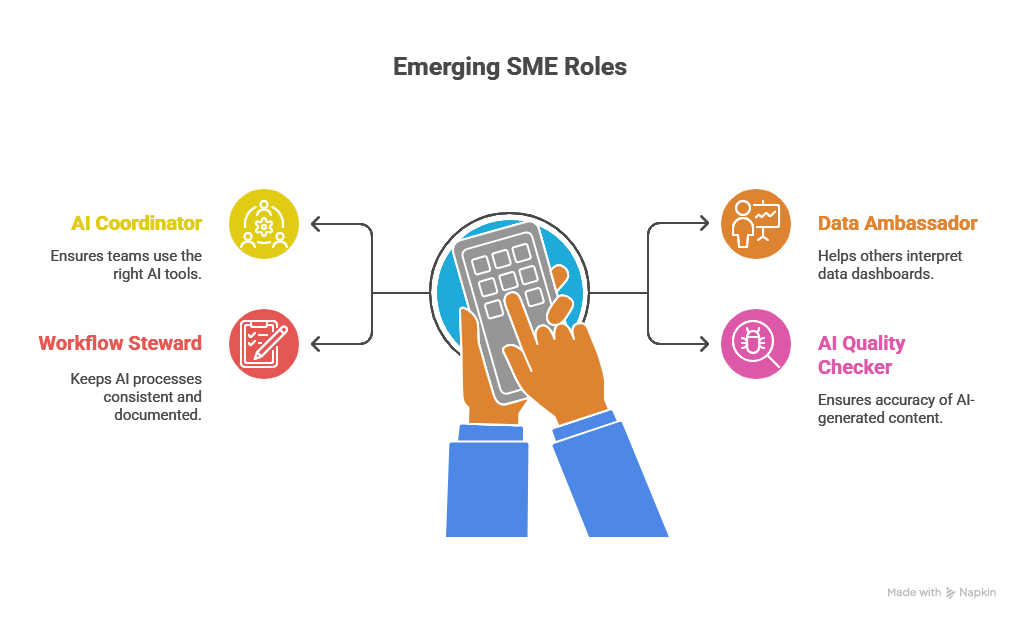
Emerging SME Roles
New roles are appearing even in small organisations:
How SMEs Can Forecast Future Skill Needs
SMEs do not need complex HR systems.
These simple approaches work:
1. Skills Mapping
Compare:
- existing employee skills
- skills required for future workflows
2. Task Projection
Ask: “In 3 years, which tasks will AI handle? Which will humans handle?”
3. Customer Trend Analysis
What customers expect guides future skills.
4. Micro-Benchmarking
Check how similar SMEs in your sector are evolving.
Example Scenario: Forecasting Skills in a Retail SME
A retail SME sees rising use of:
- AI product recommendations
- automated scheduling
- loss-prevention analytics
This implies future skills needs:
- dashboard interpretation
- customer communication
- AI-assisted merchandising
- adaptability and oversight
Reflection
- In your sector, which skills will become critical?
- Which new roles might appear?
- Which current tasks might disappear?
- What skills will YOU personally need to grow?
References
- World Economic Forum. (2023). Future of Jobs Report 2023.
- Deloitte Insights. (2022). AI and the Future of Work in SMEs.
- McKinsey Global Institute. (2021). The Future of Work after COVID-19.
- OECD. (2020). Skills Outlook: Trends and Forecasts in Workforce Development.
Unit 3: Tools for Skills Planning and Training
Introduction:
This unit equips learners with practical tools and strategies for planning workforce skills and designing training programmes in SMEs. It focuses on assessing current competencies, identifying skill gaps, implementing training, and ensuring continuous upskilling. The emphasis is on integrating AI-driven insights into workforce development, enabling employees to acquire relevant skills and remain adaptable in an evolving business environment.
Skills Mapping and Auditing
Skills mapping and audits form the foundation of workforce planning. They help SMEs understand which skills exist today, which will be required in the future, and where gaps lie.
Step-by-step approach:
- Catalogue roles and responsibilities: List every role in the SME and describe tasks, both routine and strategic.
- Identify required skills: Include both traditional and emerging skills, with particular attention to those impacted by AI adoption. For example, interpreting AI outputs, making data-informed decisions, or designing AI-assisted workflows.
- Assess current employee skills: Gather self-assessments, peer evaluations, and manager feedback. Combine these to get a complete picture of each employee’s strengths and development needs.
- Highlight gaps: Identify critical areas requiring upskilling or reskilling.
Practical Tools:
- Spreadsheets for role-to-skill mapping.
- Competency matrices using colour-coded scales (e.g., beginner, intermediate, advanced).
- Visual dashboards for leadership to quickly identify training priorities.
Application Example: A retail SME discovers its operations team is adept at manual stock management but lacks skills in interpreting AI-generated predictive reports. This audit highlights the need for targeted data literacy and analytical training.
Reflection: Consider the employees in your SME. Which skills are underdeveloped? How can a structured skills audit inform your training priorities?
Designing Training Programmes
Once skill gaps are identified, the next step is creating structured and effective training programmes.
Key Principles:
- Targeted learning: Prioritise skills with the most immediate impact, such as AI literacy, problem-solving, or customer insights interpretation.
- Flexible delivery methods: Combine online courses, workshops, on-the-job learning, mentoring, and peer-learning sessions.
- Practical application: Employees should apply skills to real-life business tasks immediately, ensuring learning is integrated into daily operations.
- Measurement and feedback: Set measurable learning objectives and track progress to assess effectiveness.
Example in Practice:
- Your SME implements AI for customer trend analysis. Training starts with online modules explaining AI reports.
- Staff then engage in exercises interpreting these reports and proposing actionable plans.
- Group reflection sessions discuss insights, errors, and opportunities, reinforcing understanding and collaborative skills.
Reflection: How can you design training that is immediately applicable to daily tasks in your SME, ensuring employees gain practical, actionable skills?
Leveraging Digital Tools for Training
AI and digital platforms enhance training effectiveness and make upskilling scalable.
Useful tools:
- Learning Management Systems (LMS): Organise training content, track individual progress, and personalise learning paths.
- AI-Powered Analytics: Monitor employee engagement, identify gaps, and recommend additional resources.
- Collaboration Platforms: Facilitate peer-to-peer learning, discussions, and project-based applications of new skills.
Implementation Example:
- An SME adopts an LMS with AI-powered dashboards to track how employees interpret AI-generated inventory forecasts.
- Employees submit reflections on decisions they make using AI insights, allowing managers to monitor progress and provide tailored guidance.
Reflection: Which digital tools could complement your training strategy? How will they integrate into existing workflows without adding complexity?
Continuous Learning and Upskilling
AI and business environments evolve quickly. SMEs must embed continuous learning into their workforce strategy.
Strategies:
- Regular skills reviews: Schedule periodic assessments to identify new gaps as technology and processes change.
- Microlearning modules: Short, focused lessons allow employees to upskill incrementally without disrupting work.
- Cross-functional projects: Encourage employees to apply skills across teams, fostering collaboration and broader learning.
- Mentorship and coaching: Pair experienced staff with learners to accelerate knowledge transfer.
Practical Illustration:
- A customer service team uses AI chatbots to manage routine queries. Upskilling focuses on complex cases and data interpretation, with team members rotating responsibilities to apply skills in different contexts.
- Regular reflection sessions review outcomes, refining the training and identifying emerging skill needs.
Reflection: How can your SME sustain continuous learning? What mechanisms support adaptability and resilience in a changing environment?
Visual Summary: Achieving Effective AI Adoption
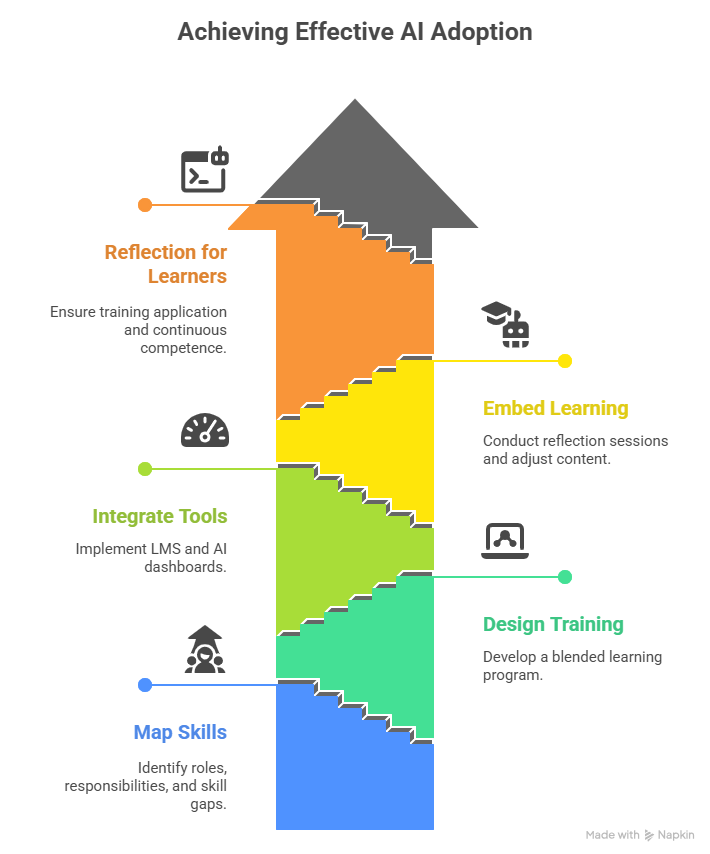
To consolidate your learning, watch the following video to learn more about this:
https://www.youtube.com/watch?v=PbmEkoiTzRY
References
- World Economic Forum. (2023). Future of Jobs Report 2023.
- Deloitte Insights. (2022). AI and Workforce Upskilling in SMEs.
- McKinsey & Company. (2021). Reskilling and Workforce Planning in the Age of AI.
- Harvard Business Review. (2020). Upskilling in a Digital World.
Unit 4: Additional Resources
World Economic Forum – Future of Jobs Report 2023
Provides an overview of global workforce trends, emerging skills, and how AI is reshaping roles across industries. Useful for understanding the broader context of future skill requirements.
https://www.weforum.org/publications/the-future-of-jobs-report-2023/
Deloitte Insights – AI and Workforce Upskilling in SMEs
Explores five guiding principles for AI inclusion, which provide a clear action framework for building an inclusive AI future.
https://www.deloitte.com/cn/en/Industries/tmt/perspectives/ai-inclusion-report.html
McKinsey & Company – Reskilling and Workforce Planning in the Age of AI
Offers guidance on how to forecast future skill needs, map workforce capabilities, and design effective upskilling strategies, with practical examples.
Harvard Business Review – Upskilling in a Digital World
Discusses how companies can implement continuous learning programmes, integrate digital tools, and develop critical future skills in their workforce.
OECD Skills Outlook 2020
Offers detailed reports on skill trends, the impact of technological change, and policy approaches to supporting skill development in SMEs.
https://www.oecd.org/en/publications/serials/oecd-skills-outlook_d4187381.html
Assessment - Case Study: Preparing a Retail SME for AI Adoption
Scenario: A Small Retail SME Adopting AI Tools
A retail SME has recently introduced an AI system that supports:
- inventory forecasting
- demand prediction
- customer purchasing insights
- automated category reports
The technology reduces manual work but has revealed new challenges.
Staff struggle with:
- interpreting AI predictions
- verifying anomalies flagged by the system
- communicating insights to colleagues
- knowing which actions to prioritise
The CEO asks you (the HR or operations manager) to create a practical workforce plan to help the team use AI effectively.
Using what you have learned in this module, produce a three-part workforce plan:
1. CURRENT IMPACT — How AI Is Changing Roles Today
Explain how tasks and responsibilities are shifting now that AI is in use.
Include:
- which routine tasks are now automated
- which new responsibilities staff have (e.g., reviewing AI outputs, interpreting data)
- which tasks still require human judgement and why
Keep this section focused on current transformation (Unit 1).
2. FUTURE SKILLS — What Skills the SME Will Need in the Next 3–5 Years
Identify the most important future skills based on Unit 2.
Choose 3–5 priority skills, such as:
- data literacy
- analytical thinking
- adaptability
- ethical AI use
- digital communication
Explain why each skill is needed based on the SME’s context.
You may also identify one or two emerging micro-roles, such as:
- Data Ambassador
- AI Quality Checker
- Workflow Steward
3. TRAINING PLAN — How the SME Will Build These Skills
Develop a short, realistic training plan aligned with Unit 3.
Include:
- the results of a simple skills audit (who needs what)
- 2–3 training methods you will use (microlearning, on-the-job practice, tool tutorials, peer learning)
- how continuous learning will be built into the team’s routine
- how progress will be monitored (monthly check-ins, dashboard reviews, staff feedback)
Format
You can choose any of the following formats:
- a short written report
- a one-page workforce plan
- a 3-column table (“Current shifts”, “Future skills”, “Training plan”)
- a slide-style summary
Reflection Questions
- Which tasks in this SME require human oversight despite automation?
- Where might AI outputs be misleading, and how should staff verify them?
- Which training approach would realistically work best for this team?
- How might this plan need to change as new AI tools appear?

Funded by the European Union. Views and opinions expressed are however those of the author(s) only and do not necessarily reflect those of the European Union or the European Education and Culture Executive Agency (EACEA). Neither the European Union nor EACEA can be held responsible for them. [Project number: 2024-1-AT01-KA220-VET-000245796]